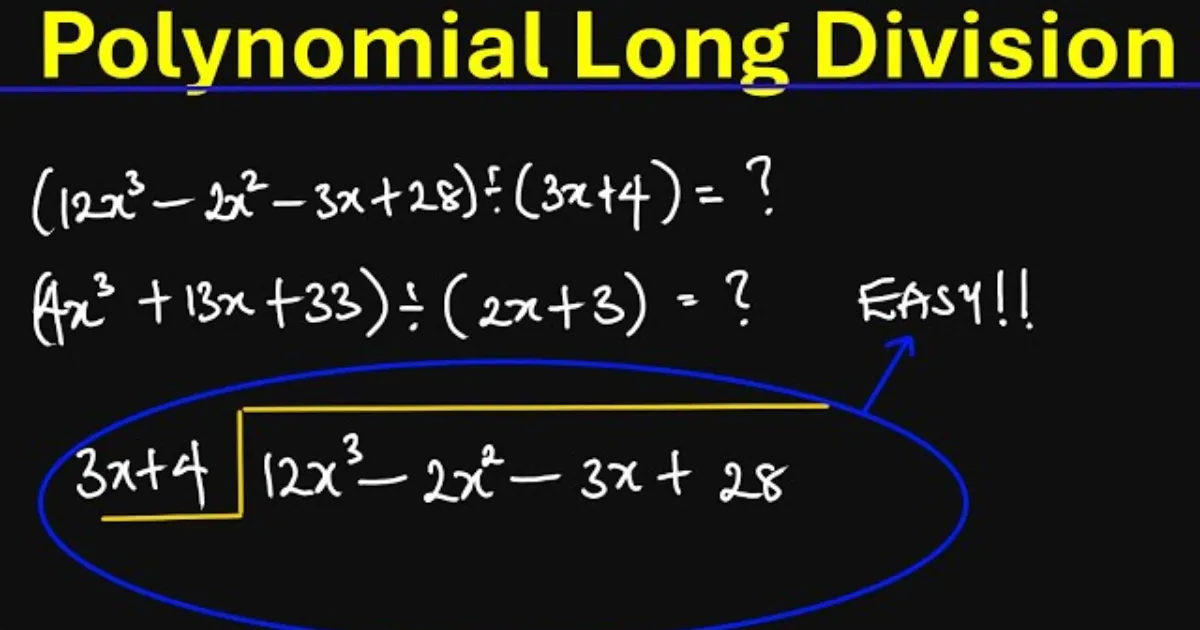
How to Master Polynomial Long Division Without the Headache
Let’s be honest: the moment a math problem shifts from simple numbers to a string of $x^2$, $y^3$, and nested parentheses, most people feel a sudden urge to close the textbook. Polynomial long division is one of those academic hurdles that feels unnecessarily complex, often leading to “sign errors” that ruin the entire calculation. Whether you are a student trying to ace your algebra exam or a professional dealing with complex functions, the manual process is tedious and prone to human slip-ups.
That is where a Polynomial Long Division Calculator becomes your best friend. Instead of spending twenty minutes scratching your head over a single remainder, this tool breaks down the process instantly. It doesn’t just give you the answer; it mirrors the logical flow of a mathematician, helping you visualize the “divide, multiply, subtract, bring down” cycle. In this guide, we’ll explore how this tool works, the logic behind it, and how you can use it to master your coursework.
What is a Polynomial Long Division Calculator and Why it Matters
At its core, a Polynomial Long Division Calculator is a specialized digital engine designed to divide one polynomial (the dividend) by another (the divisor) of the same or lower degree. If you remember long division from third grade—where you find how many times 5 goes into 27—this is the “grown-up” version. Instead of simple integers, we are dealing with terms like $3x^3 + 2x – 5$.
Why is this tool essential?
- Factoring Higher-Degree Equations: When you need to find the roots of a cubic or quartic function, division is often the only way to “break down” the equation into manageable parts.
- Identifying Asymptotes: In calculus, dividing polynomials helps you find slant asymptotes, which are crucial for graphing rational functions.
- Accuracy and Speed: A single missed negative sign in the subtraction phase cascades through the rest of the problem. A calculator eliminates this risk, providing a perfect “check” for your manual work.
- Conceptual Clarity: By seeing the step-by-step breakdown, users can identify exactly where their manual logic went wrong, making it an excellent tutoring aid.
Step-by-Step Guide: Using the Calculator Effectively
Using the tool is straightforward, but inputting your data correctly is key to getting the right result. Follow these steps:
-
Step 1: Arrange your Terms. Ensure both your dividend and divisor are in descending order of power (e.g., $x^2 + 5x + 6$ instead of $5x + 6 + x^2$).
-
Step 2: Account for Missing Powers. If your equation is $x^3 + 1$, you must treat it as $x^3 + 0x^2 + 0x + 1$. Most calculators need these “placeholders” to align columns correctly.
-
Step 3: Input the Dividend. Enter the primary polynomial you want to divide into the first input box.
-
Step 4: Input the Divisor. Enter the polynomial you are dividing by into the second box.
-
Step 5: Calculate. Hit the “Solve” or “Divide” button.
-
Step 6: Review the Breakdown. The tool will present the Quotient (the result) and the Remainder (what’s left over). Many tools will also show the long-form “tableau” showing each subtraction step.
The Math Behind the Tool: The Division Algorithm
The calculator follows a very specific mathematical protocol known as the Division Algorithm for Polynomials. To understand what the tool is doing under the hood, we use this fundamental formula:
Where:
- $P(x)$ is the Dividend (the total value).
- $D(x)$ is the Divisor (what you are dividing by).
- $Q(x)$ is the Quotient (how many times it fits).
- $R(x)$ is the Remainder (the leftover part, which must be of a lower degree than the divisor).
The process mimics basic arithmetic division. The tool looks at the leading term of the divisor and asks, “What do I need to multiply this by to match the leading term of the dividend?” It then multiplies the entire divisor by that factor, subtracts it from the dividend, and repeats the process with the new result until the remaining degree is lower than the divisor’s degree.
Real-Life Scenarios: When Will You Use This?
Polynomial division isn’t just for passing a test; it has practical applications in science and finance.
Scenario 1: Engineering and Signal Processing
Engineers often use polynomial division when working with System Transfer Functions. If an engineer needs to simplify a complex feedback loop in a circuit, they may divide two high-order polynomials to determine the stability of the system.
Scenario 2: Financial Modeling
In advanced quantitative finance, analysts use polynomial interpolation to predict market trends. If a model generates a complex curve representing interest rate changes, dividing that polynomial can help isolate “linear trends” from “noise” or volatile remainders.
Scenario 3: Physics (Projectiles)
If a physicist has a polynomial representing the path of a projectile influenced by air resistance, they might divide that function by a linear factor (like time) to find the average velocity or to simplify the equation for specific intervals of flight.
FAQs: Common Questions About Polynomial Division
1. What is the difference between Long Division and Synthetic Division?
Synthetic division is a “shortcut” method, but it only works when your divisor is a linear factor in the form $(x – c)$. Polynomial long division is more versatile because it works for any divisor, including quadratic or cubic ones.
2. Can the remainder be a negative number?
Absolutely. In polynomial division, the “remainder” is itself a polynomial. It can have negative coefficients or even be a negative constant.
3. What does it mean if the remainder is zero?
If $R(x) = 0$, it means the divisor is a factor of the dividend. This is incredibly helpful for solving equations because it tells you that you’ve found an exact “root” or piece of the puzzle.
Conclusion: Simplify Your Math Journey
Polynomial long division doesn’t have to be a source of frustration. By understanding the underlying algorithm and utilizing a Polynomial Long Division Calculator, you can transform a tedious 20-minute chore into a 5-second verification. This tool allows you to focus on the “why” of the math rather than getting bogged down in the “how” of repetitive subtraction.
Ready to clear your homework queue? Try our Polynomial Long Division Calculator today to get instant, step-by-step solutions and master your algebra goals!
Leave a Reply