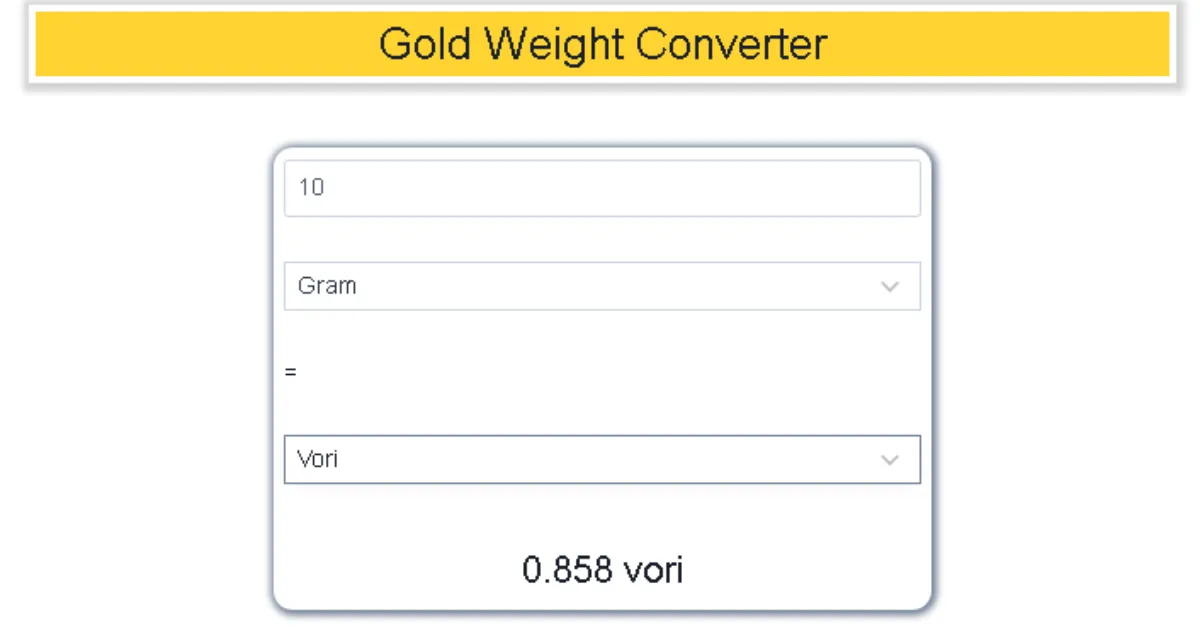
Navigating the world of precious metals can feel like learning a second language, especially when you encounter traditional units like the Tola. If you’ve ever walked into a jewelry shop in South Asia or checked gold rates online, you’ve likely seen prices quoted in both grams and tolas. But how do you know exactly what you’re paying for?
The Gold Price Weight Converter (Tola to Gram) is your essential bridge between heritage and modern precision. Whether you are inheriting family heirlooms, planning a wedding purchase, or investing in gold bullion, understanding this conversion is the only way to ensure you aren’t overpaying. In this guide, we’ll break down why these units exist, the exact math used by jewelers today, and how you can use our conversion logic to trade gold like a pro.
What is a Tola and Why Does it Matter?
The Tola is a traditional unit of mass that has been the heartbeat of the gold trade in South Asia—specifically India, Pakistan, Bangladesh, and Nepal—for centuries. Its roots trace back to the Vedic period, derived from the Sanskrit word Tula, meaning a balance or scale. Historically, a tola was equivalent to the weight of 100 Ratti seeds, making it a natural, standardized way for ancient merchants to trade fairly.
In the modern era, while the world has largely shifted to the metric system (grams and kilograms), the gold industry remains deeply sentimental. Most local “Sarafa” markets still quote daily rates in tolas. Understanding the Gold Price Weight Converter matters because:
- Price Transparency: Global gold spot prices are quoted in Troy Ounces or Grams. To compare a local price to the international market, you must convert the weight accurately.
- Jewelry Valuation: Most traditional jewelry designs are crafted based on tola weights (e.g., a “5-tola set”).
- Investment Accuracy: When buying gold biscuits or coins, even a 0.1-gram discrepancy can lead to a significant financial difference given today’s high gold prices.
Step-by-Step Guide: How to Convert Tola to Grams
- Using a Gold Price Weight Converter is straightforward once you know which “standard” your jeweler is using. Follow these steps to get an exact measurement:
- Identify the Regional Standard: * International/Standard Tola: Used most officially, this is 11.6638 grams.
- Modern/Jeweler’s Tola: Many modern jewelers round this to 10 grams or 12 grams for easier math. Always ask: “How many grams are you counting in one tola?”
- Determine Your Total Tolas: Look at your gold receipt or the weight of the item you are interested in.
- Apply the Conversion Factor: * To get Grams, multiply your Tolas by 11.6638.
- To get Tolas, divide your Grams by 11.6638.
- Verify the Purity: Remember that the weight (grams) stays the same regardless of whether the gold is 22K or 24K, but the price will change based on that weight.
- Calculate the Final Value: Multiply the resulting gram weight by the current “Gold Price per Gram” in your city.
The Math Behind the Gold Weight Conversion
- The science of the Tola was standardized during the British Raj in 1833. It was defined as 180 troy grains. To understand how we arrive at the modern metric equivalent, we use the following relationship:
- $$1 \text{ Tola} = 11.6638038 \text{ grams}$$
- For most commercial purposes, this is rounded to 11.66 grams. If you are looking for the inverse (how many tolas are in a single gram), the formula is:
- $$1 \text{ Gram} \approx 0.0857 \text{ Tolas}$$
- In some specific markets, like Pakistan, a “local tola” is sometimes treated as exactly 12.5 grams (based on a different historical division where 1 kg = 80 tolas). However, the $11.66$ figure remains the most widely accepted standard for high-end gold trading.
- Real-Life Scenarios: Tola vs. Gram in Action
- To see how the Gold Price Weight Converter affects your wallet, let’s look at two practical examples:
Scenario A: Buying a Wedding Set
- Imagine you are buying a necklace that the jeweler says weighs 4.5 Tolas. If the current gold rate is $80 per gram, how much is the gold worth?
-
Conversion: $4.5 \times 11.6638 = 52.48 \text{ grams}$
-
Total Cost: $52.48 \times 80 = \$4,198.40$
-
Note: Without the converter, you might mistake 4.5 tolas for 45 grams, leading to a massive error in your budget!
- Scenario B: Selling Heirloom Coins
- You have three old gold coins that weigh a total of 35 grams on a kitchen scale. You want to know how many tolas that is to check the local newspaper rates.
-
Conversion: $35 \div 11.6638 = 3.00 \text{ Tolas}$
-
You now know you have exactly 3 tolas of gold to trade.
FAQs: Frequently Asked Questions
- 1. Is 1 Tola always equal to 10 grams?
- No. While some jewelers use 10 grams as a “metric tola” to simplify calculations, the official and traditional weight is 11.6638 grams. Always clarify the conversion rate with your dealer before paying.
- 2. Does the weight of a Tola change with gold purity (22K vs 24K)?
- No, the weight remains the same. A tola is a measure of mass, not purity. However, a tola of 24K gold will be more expensive than a tola of 22K gold because it contains more pure gold content.
- 3. Why do some countries use different weights for a Tola?
- Tradition varies by region. For instance, in parts of Pakistan, a tola is often calculated as 12.5 grams to align with the “80 tolas per kilogram” rule. In India, 11.66 grams is the standard.
- Conclusion & CTA
- Understanding the Gold Price Weight Converter (Tola to Gram) is the hallmark of a savvy investor. By mastering the 11.6638 ratio, you protect yourself from market confusion and ensure every milligram of your precious metal is accounted for.
- Ready to make an informed investment? Use our digital conversion tool today to get real-time weight calculations and stay ahead of the market!
Leave a Reply