Why Your Electricity Bill Is Rising and How to Control It
Managing household expenses in Pakistan has become a significant challenge, with electricity costs leading the charge. Whether you are a resident of Lahore served by LESCO or living in the bustling metropolis of Karachi under K-Electric, understanding your bill is no longer optional—it is a necessity for financial survival.
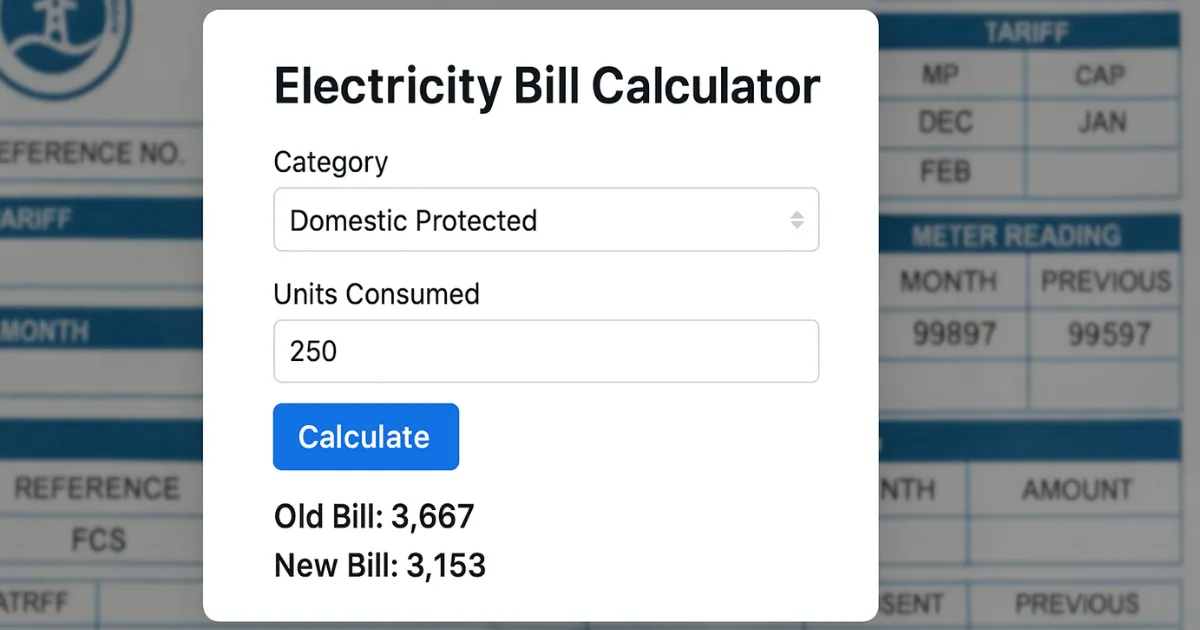
The Electric Unit Cost Calculator is a vital tool designed to strip away the complexity of “slabs,” “surcharges,” and “adjustments.” Many consumers are shocked to see their bills double even when their usage only increases by a few units. This happens because of the progressive slab system used by NEPRA. This guide and tool empower you to predict your monthly costs before the bill arrives, allowing you to adjust your consumption patterns in real-time. By the end of this article, you’ll not only know how to calculate your costs but also how to dodge the most expensive billing traps.
What is the Electric Unit Cost Calculator and Why it Matters
The Electric Unit Cost Calculator (LESCO/KElectric) is a specialized digital tool that computes your total electricity payable amount based on the current year’s tariff rates. In Pakistan, electricity is not sold at a flat rate; instead, the price per unit ($kWh$) increases as you cross specific thresholds known as “slabs.”
Why This Tool is Essential in 2026
As of March 2026, the energy landscape in Pakistan has seen several updates:
- Slab Progression: Crossing the 200 or 300-unit mark can trigger a massive jump in the base rate, sometimes moving from Rs. 13 to over Rs. 30 per unit instantly.
- Fuel Price Adjustments (FPA): These are monthly variables. For instance, in March 2026, an FPA of approximately Rs. 1.98 per unit was introduced to account for global fuel fluctuations.
- Protected vs. Non-Protected Status: The government distinguishes between “Protected” consumers (those using consistently low energy) and “Non-Protected” consumers. The calculator helps you identify which category you fall into.
Using this tool matters because it provides transparency. It breaks down the “hidden” costs like the Electricity Duty, PTV Fee, and GST, which often make up 20% to 30% of your total bill.
Step-by-Step Guide: How to Use the Calculator
Using the calculator is straightforward. Follow these steps to get an accurate estimate of your LESCO or K-Electric bill:
-
Check Your Meter Reading: Go to your physical meter and note the current reading (the numbers followed by $kWh$). Compare this with the “Current Reading” on your previous month’s bill.
-
Calculate Units Consumed: Subtract the old reading from the new one.
-
Example: $12,500$ (Current) – $12,200$ (Previous) = $300$ units.
-
-
Select Your Provider: Choose LESCO (for Lahore and surrounding areas) or K-Electric (for Karachi) from the tool’s dropdown menu.
-
Enter Your Connection Type: Select “Residential,” “Commercial,” or “Industrial.” Most homes use the A-1 Residential tariff.
-
Input Consumed Units: Type the number of units you calculated in Step 2.
-
Review the Breakdown: The tool will instantly generate a report showing:
- Cost of Electricity: The price based on your specific slab.
- FCA/QTA: The latest fuel and quarterly adjustments.
- Government Taxes: GST, Income Tax, and Surcharges.
7.Final Total: This is the amount you will likely see on your next bill.
The Math Behind the Bill: Understanding the Formula
Calculating an electric bill in Pakistan isn’t as simple as multiplying units by a single rate. It follows a Cumulative Slab Logic.
The Base Formula
The total cost of electricity ($TC$) is calculated as:
Where:
- $U$: Units within a specific slab.
- $R$: The rate assigned to that slab.
2026 Tariff Example (Non-Protected)
-
1 – 100 Units: Approx. Rs. 22.44
-
101 – 200 Units: Approx. Rs. 28.91
-
201 – 300 Units: Approx. Rs. 33.10
If you consume 250 units, you don’t pay Rs. 33.10 for all of them. The math works like this:
-
First 100 units $\times$ 22.44 = Rs. 2,244
-
Next 100 units $\times$ 28.91 = Rs. 2,891
-
Remaining 50 units $\times$ 33.10 = Rs. 1,655
-
Total Variable Cost: Rs. 6,790 (plus taxes and surcharges).
Note: Once you cross 700 units, the rate for all units often jumps to the highest tier (e.g., Rs. 47.69 per unit), making the “cliff” very steep.
Real-Life Scenarios
Scenario 1: The “Protected” Small Household
Ali lives in a small apartment and uses only fans and LED lights. He consumes 190 units. Because he has stayed under 200 units for six consecutive months, he is a Protected Consumer.
-
His Rate: Approx. Rs. 13.01 per unit.
-
Estimated Bill: ~Rs. 2,500 (low taxes).
Scenario 2: The Summer Peak (AC Usage)
Sara uses one Inverter AC during the night in Lahore (LESCO). Her total consumption hits 450 units.
-
Her Status: Non-Protected.
-
The Result: She enters the Rs. 40.22 slab.
-
Estimated Bill: Between Rs. 22,000 and Rs. 25,000 after including GST (18%), FPA, and Electricity Duty.
Scenario 3: The Commercial Shop
A small mobile shop in Karachi (K-Electric) uses 350 units. Commercial rates are higher, roughly Rs. 45.43 per unit flat.
-
Estimated Bill: ~Rs. 16,000 + Fixed charges.
Frequently Asked Questions (FAQs)
1. What is the difference between Protected and Non-Protected consumers?
Protected consumers are those who use less than 200 units per month for six consecutive months. They enjoy a much lower base rate. Once you exceed 200 units in a single month, you risk losing this status and being moved to the significantly more expensive Non-Protected category.
2. Why is my bill higher even if my units are the same as last month?
This is usually due to Fuel Price Adjustment (FPA) or Quarterly Tariff Adjustment (QTA). These charges reflect the change in the cost of fuel (like LNG or Coal) used to generate power. For March 2026, a combined hike of Rs. 1.98 per unit was applied.
3. Does the calculator include GST and other taxes?
Yes, a professional calculator accounts for the 18% GST, Electricity Duty (1.5%), and the PTV Fee (Rs. 35). However, Income Tax is only applied to non-filers or bills exceeding certain thresholds.
Conclusion & CTA
Understanding your electricity costs is the first step toward energy independence. By using our Electric Unit Cost Calculator (LESCO/KElectric), you can stop guessing and start planning. Whether you need to decide if you should switch to Solar or simply want to know if you can afford to run the AC for another hour, this tool is your financial compass.
Leave a Reply